
Last updated: November 3, 2026 – By Diane Holcomb
November 2026 update: reconfirmed gasket pricing and the intake-vs-exhaust point.
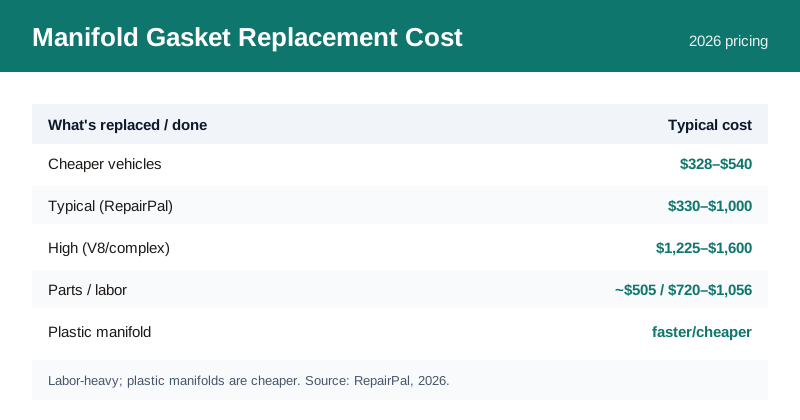
A manifold gasket replacement runs about $328 to $540 on simpler vehicles, $330 to $1,000 typically, and $1,225 to $1,600 on V8 or complex engines (per RepairPal, for intake manifold gaskets). Parts are often around $505 and labor $720 to $1,056 on the high end – because the manifold has to come off the engine, which is the labor-heavy part. A “manifold gasket” can mean two different things: the intake manifold gasket (which seals the air-intake manifold to the cylinder head, and on many engines also seals coolant passages) or the exhaust manifold gasket (which seals the exhaust manifold to the head). An intake gasket leak causes a rough or high idle, a vacuum leak, or a coolant leak; an exhaust gasket leak causes a ticking/tapping exhaust leak (loudest on a cold start). Either way, labor dominates the cost because the manifold must be removed.
“Manifold gasket” could be the intake or exhaust side – different symptoms, same labor-heavy reality. Let me break it down.
What you’ll actually pay
Here’s the picture. These are estimates that vary a lot by vehicle and shop.
| Item | Cost | Notes |
|---|---|---|
| Simpler vehicles | $328–$540 | 4-cylinder, easy access |
| Typical | $330–$1,000 | Most cars |
| V8 / complex engines | $1,225–$1,600 | More teardown |
| Parts / labor (high) | ~$505 / $720–$1,056 | Labor dominates |
Which manifold gasket depends on the leak; our intake manifold guide, exhaust manifold guide, and coolant leak guide cover the specifics.
Shop Talk
First, figure out which manifold gasket you mean, because they leak differently. The intake manifold gasket seals the air-intake manifold to the cylinder head (and on lots of engines also seals coolant passages). When it leaks, you get a vacuum leak – a rough, high, or surging idle and often a lean code – or, on engines with coolant running through the manifold, a coolant leak and dropping coolant. The exhaust manifold gasket seals the exhaust manifold to the head; when it leaks you get a ticking or tapping exhaust leak that’s loudest on a cold start and quiets as the engine warms. Different symptoms, so a shop confirms which. The common thread is labor: the gasket itself is cheap, but reaching it means pulling the manifold, which can involve draining coolant, removing the throttle body, fuel rails, wiring, and other parts – on a V8 or a tight engine bay, that’s a lot of hours, which is why the same “gasket” job ranges from $330 to $1,600. A couple of money angles: because the manifold’s already off, do the related cheap parts (gaskets, O-rings, worn hoses) while you’re in there so you don’t pay that labor twice; and on the exhaust side, expect a shop to warn about rusted manifold bolts that can snap on an older vehicle and add labor. Plastic intake manifolds are generally faster (cheaper) to service than cast.
Where Drivers Overpay
The first step that saves money is diagnosis: confirming whether it’s the intake gasket (rough idle, vacuum or coolant leak) or the exhaust gasket (cold-start tick) so the right side gets done – and whether it’s just the gasket versus a cracked manifold.
Since the labor to pull the manifold is the whole bill, the save is bundling the cheap related parts (gaskets, O-rings, aging hoses) while it’s open, so you don’t pay that teardown twice. The pattern: confirm intake vs exhaust and gasket vs cracked manifold, do the related parts while open, and on the exhaust side get a heads-up about rusted bolts.
The Real Number
A manifold gasket is $328 to $540 on simpler engines, $330 to $1,000 typically, and $1,225 to $1,600 on V8/complex engines – the gasket is cheap, labor to pull the manifold dominates. Confirm whether it’s the intake gasket (rough idle, vacuum or coolant leak) or the exhaust gasket (cold-start tick). Since the manifold’s off anyway, do the cheap related parts at the same time, and expect rusted-bolt warnings on the exhaust side of older vehicles.
Frequently Asked Questions
How much does a manifold gasket replacement cost?
About $328 to $540 on simpler vehicles (small engines with easy access), $330 to $1,000 typically, and $1,225 to $1,600 on V8 or complex engines, per RepairPal’s intake manifold gasket estimates. Parts are often around $505 and labor $720 to $1,056 on the high end. These are estimates that vary widely by vehicle and shop. The gasket itself is inexpensive; the cost is the labor to remove the manifold, which can mean draining coolant and taking off the throttle body, fuel rails, wiring, and other components – far more involved on a V8 or in a tight engine bay. Plastic intake manifolds are generally faster and cheaper to service than cast ones. The figure also depends on whether it’s the intake or exhaust manifold gasket. Confirming which gasket is leaking, and doing the cheap related parts while the manifold’s off, determines the accurate cost.
What’s the difference between an intake and exhaust manifold gasket?
They seal two different manifolds, with different jobs and leak symptoms. The intake manifold gasket seals the intake manifold (which distributes air, or air-fuel mixture, into the cylinders) to the cylinder head, and on many engines also seals coolant passages that run through the manifold. When it leaks, you get a vacuum leak – rough or high idle, surging, a lean condition – or a coolant leak on engines where coolant flows through the manifold. The exhaust manifold gasket seals the exhaust manifold (which collects hot exhaust gases from the cylinders) to the head. When it leaks, you get an exhaust leak – a ticking or tapping noise loudest on a cold start that quiets as the engine warms, sometimes with a burning smell. So “manifold gasket” is ambiguous: a rough idle or coolant leak points to the intake gasket, while a cold-start tick points to the exhaust gasket. A shop confirms which, and that determines the specific repair. See our intake and exhaust manifold guides.
What are the symptoms of a leaking manifold gasket?
It depends which gasket. A leaking intake manifold gasket causes a rough, high, or surging idle, hesitation, a lean condition with a check engine light, sometimes an audible vacuum hiss, and – on engines where coolant runs through the intake manifold – a coolant leak, dropping coolant level, or overheating. A leaking exhaust manifold gasket causes a ticking or tapping exhaust noise that’s loudest when the engine is cold and quiets as it warms (because the metal expands and seals the leak), sometimes with a burning smell, reduced power, or a check engine light from skewed oxygen-sensor readings. Because these symptoms overlap with other issues (a separate vacuum leak, another coolant leak, or a cracked manifold rather than just the gasket), a shop should pinpoint the source before repair. The key distinction: idle/vacuum/coolant problems point to the intake gasket, while a cold-start tick points to the exhaust gasket. Diagnosis confirms which and whether it’s the gasket or the manifold itself.
Why does the labor cost so much?
Because the manifold has to come off the engine to reach the gasket, and getting there means removing a lot of surrounding parts. For an intake manifold gasket, the tech may have to remove the throttle body, fuel rails, wiring harnesses, hoses, and other components, and drain coolant on engines where coolant runs through the manifold. For an exhaust manifold gasket, reaching and unbolting the manifold can be tight, and rusted bolts often snap and need extraction. On a V8 or an engine with a crowded bay, this is many hours of labor, which is why the job can run over $1,000 even though the gasket costs little. On a simpler 4-cylinder with good access, it’s much less. That’s the pattern with many gasket and seal jobs – the part is cheap, the access is expensive. So when a manifold gasket quote seems high, the labor to disassemble, replace, and reassemble is the reason, not the gasket itself. The engine’s complexity and layout drive the number.
Should other parts be done while the manifold is off?
Usually yes, and it’s good value given the labor. Once the manifold is removed, several inexpensive related parts become easily accessible that would otherwise require their own teardown later. On an intake manifold job, that often includes the intake gaskets and O-rings (always replaced), plus things like certain hoses, the PCV valve, spark plugs on some engines, and coolant parts or a thermostat depending on the engine. On an exhaust job, it’s the gaskets and any corroded hardware. Doing these cheap items while the manifold’s already off means you don’t pay the same big access labor again soon when one fails. A good shop will point out the related parts worth doing at the same time. You don’t have to replace everything, but the gaskets are mandatory and bundling a few aging related parts is smart. It’s the same shared-labor logic as doing a water pump with a timing belt – handle the cheap stuff while access is already paid for.
Is it a gasket leak or a cracked manifold?
That distinction affects the cost, and it takes an inspection to tell. A gasket leak is a failure of the seal between the manifold and the cylinder head – the manifold is fine, just the gasket (and sometimes bolts) needs attention, which is the repair described here. A cracked manifold means the manifold body itself has fractured, which requires replacing the manifold (more expensive). On the intake side, many modern engines use plastic intake manifolds that can crack with age, leaking air or coolant – a known failure on certain engines – in which case you replace the manifold, not just the gasket. On the exhaust side, cast-iron manifolds can crack from years of heat cycling, also requiring replacement. So a shop should determine whether the leak is at the gasket/seal or from a crack in the manifold body, because that changes the parts and the price. A gasket-only repair is cheaper; a cracked manifold means buying the manifold too. Diagnosis confirms which you’re facing.
Can I drive with a leaking manifold gasket?
It depends on the type of leak. A leaking intake manifold gasket causing a vacuum leak usually leaves the car drivable but with a rough or high idle, possible stalling, and reduced efficiency – not an immediate emergency, but worth fixing. If the intake gasket is leaking coolant (on engines where coolant runs through it), that’s more serious, because losing coolant risks overheating and engine damage, so that type shouldn’t be driven on long. A leaking exhaust manifold gasket is usually drivable short-term (a ticking noise, some lost efficiency), but an exhaust leak can let fumes toward the cabin and skew the oxygen sensors, so it’s worth fixing and more urgent if you smell exhaust inside. So a mild vacuum or exhaust leak gives you some time, but a coolant-related intake leak is a fix-it-soon situation. Either way, it’s best to have the leak diagnosed and repaired rather than let it worsen – and to know which type you have and how urgent it is.
Sources
Price ranges verified against 2026 manifold gasket pricing in November 2026. Dollar amounts are estimates that vary by vehicle and shop.
- RepairPal – intake manifold gasket replacement cost
- RepairPal – exhaust manifold gasket replacement cost
- ASE – National Institute for Automotive Service Excellence
Related Guides
- Intake Manifold Repair Cost
- Exhaust Manifold Repair Cost
- Coolant Leak Repair Cost
- Thermostat Gasket Replacement Cost
- Car Repair Cost Estimator

Diane Holcomb spent seven years as a service advisor at multi-brand dealerships in Charlotte, NC, where “manifold gasket” always got nailed down first – intake (rough idle, coolant) or exhaust (cold-start tick) – because they’re different repairs sharing the same labor-heavy teardown. She drives a 2019 Honda CR-V and a hand-me-down 2007 Toyota Camry, and takes no referral fees or advertising money from any shop or chain.