
Last updated: November 2, 2026 – By Diane Holcomb
November 2026 update: reconfirmed gas cap, hose, purge valve, and canister pricing.
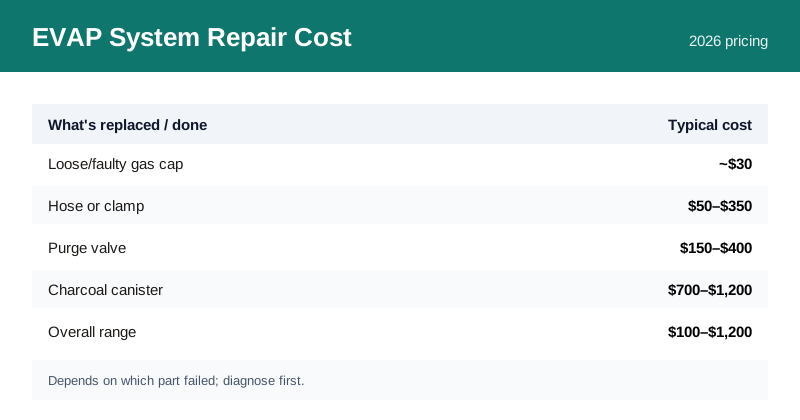
An EVAP system repair ranges from almost nothing to over a thousand dollars, because “EVAP leak” covers many parts. The most common cause – a loose, cracked, or missing gas cap – is about $30, and sometimes free (just tighten it). A hose or clamp runs $50 to $350, a purge valve $150 to $400, and a charcoal canister $700 to $1,200. Overall, most EVAP repairs land between $100 and $1,200. The EVAP (evaporative emission control) system captures gasoline vapors from the fuel tank and routes them to be burned in the engine instead of escaping into the air. When it leaks, a check engine light comes on (often codes like P0440, P0442 for a small leak, P0455 for a large one, or P0456 for a very small one). Because the price depends entirely on which part is leaking, a proper diagnosis comes first.
The one thing to try before spending a dime is your gas cap. Let me cover that and the rest of the system.
What you’ll actually pay
Here’s the range by part. These are estimates that vary by vehicle and shop.
| Part | Cost | Notes |
|---|---|---|
| Gas cap | ~$30 | Or free to tighten |
| Hose / clamp | $50–$350 | Common |
| Purge valve | $150–$400 | See purge valve guide |
| Charcoal canister | $700–$1,200 | Larger job |
The purge valve is a frequent EVAP culprit on its own; our purge valve guide breaks it down, and the car diagnostic testing and cost guide covers the scan that finds the leak.
Shop Talk
Before you pay anyone, check your gas cap – it’s the single most common cause of an EVAP light and the cheapest fix by far. Make sure it’s on and clicked tight (a lot of EVAP lights come from a cap not turned until it clicks after a fill-up). Look at the rubber seal; if it’s cracked, hard, or torn, a new cap is about $30. After tightening or replacing it, the light may take a few drive cycles to clear on its own, or a shop can clear it. If the light comes back, then it’s worth paying for a real diagnosis. Here’s why diagnosis matters so much on EVAP: the system is sealed and tested with smoke, and the leak can be a tiny cracked hose, a stuck purge or vent valve, or the charcoal canister – parts that range from $50 to over $1,000. Throwing a purge valve at it because that’s the common one, without a smoke test, is how people pay twice. One more real-world note: an EVAP leak won’t hurt how the car drives or damage the engine, so while you shouldn’t ignore it (it’ll fail emissions testing and the light hides other codes), you usually have time to diagnose it properly rather than rushing into the priciest part.
Where Drivers Overpay
The number-one overpay is paying for parts before checking the gas cap. A huge share of EVAP lights are just a loose or cracked cap – a free tighten or a $30 part – so that’s the first and cheapest thing to rule out.
The second is skipping the smoke test and replacing the “usual” part on a guess. The leak could be a $50 hose or a $1,200 canister, and a smoke test finds the actual source so you buy one part, not three. The pattern: tighten or replace the cap first, let the light clear, and if it returns, pay for a proper smoke-test diagnosis before replacing anything bigger.
The Real Number
An EVAP repair runs anywhere from about $30 (a gas cap) to $700–$1,200 (a charcoal canister), with hoses $50–$350 and a purge valve $150–$400. Check and tighten your gas cap first – it’s the most common and cheapest cause. If the light returns, pay for a smoke-test diagnosis so you replace the one part that’s actually leaking. An EVAP leak won’t hurt the engine, so you have time to diagnose it right instead of guessing at the priciest part.
Frequently Asked Questions
How much does it cost to fix an EVAP leak?
It ranges widely because it depends on which part is leaking. A loose or faulty gas cap – the most common cause – is about $30, and sometimes free if it just needs tightening. A cracked hose or clamp runs $50 to $350, a purge valve $150 to $400, and a charcoal canister $700 to $1,200. Most EVAP repairs land between $100 and $1,200 overall, plus a diagnostic fee for the smoke test that finds the leak. These are estimates that vary by vehicle and shop. Because the cost swing is so large, a proper diagnosis before buying parts is what keeps you from overpaying. Always check the gas cap first, since that’s the cheapest possible fix.
What is the EVAP system and what does it do?
The EVAP (evaporative emission control) system captures gasoline vapors from the fuel tank and keeps them from escaping into the atmosphere. Fuel evaporates, especially as temperatures rise, and instead of venting those vapors, the EVAP system stores them in a charcoal canister and later routes them into the engine to be burned during normal running, controlled by a purge valve and a vent valve. It’s a sealed system, monitored by the car’s computer, which periodically tests it for leaks. When it finds one – even a very small one – it sets a check engine light. The system is about emissions and fuel-vapor control, not engine performance, which is why an EVAP leak usually doesn’t change how the car drives.
Can a loose gas cap really cause a check engine light?
Yes – it’s one of the most common check engine light causes, and the cheapest to fix. The gas cap seals the fuel system, so if it’s loose (not clicked tight after refueling), cracked, or has a worn-out rubber seal, the EVAP system detects the leak and turns on the light. The fix is often as simple as tightening the cap until it clicks, or replacing it for about $30 if the seal is bad. After that, the light usually clears on its own within a few drive cycles, or a shop can clear it. So before paying for any diagnosis or parts, check your gas cap. It’s worth doing first every time an EVAP-related light appears, because it’s free to rule out.
Is it safe to drive with an EVAP leak?
Generally yes, in the short term – an EVAP leak doesn’t affect how the engine runs, won’t damage the engine, and isn’t a safety hazard in normal driving. The system handles fuel vapors, not the running of the engine, so you won’t notice drivability problems from an EVAP code alone. That said, you shouldn’t ignore it indefinitely for two reasons: a car with an EVAP code will fail an emissions or smog test, and while the check engine light is on for EVAP, it can mask a new, more serious code that appears later. So it’s fine to take your time diagnosing it properly rather than rushing, but plan to fix it, especially before an emissions test. Check the gas cap first.
Why do I need a smoke test for an EVAP leak?
Because the EVAP system is sealed, and a leak can be anywhere in it, a smoke test is the reliable way to find the actual source. The shop introduces a harmless smoke (often with a dye) into the sealed system under low pressure and watches where it escapes – a cracked hose, a bad seal, a stuck valve, or the canister. This pinpoints the leak so you replace the one part that’s failing instead of guessing. Guessing is expensive on EVAP: the common parts range from a $50 hose to a $1,200 canister, so replacing the “usual suspect” without confirming can mean paying for parts that weren’t the problem. The diagnostic fee for a smoke test is small next to the cost of replacing the wrong part.
What is a purge valve and how does it fit in?
The purge valve (also called the purge solenoid) is one of the most common EVAP failure points. It’s the valve that opens to let the stored fuel vapors flow from the charcoal canister into the engine’s intake to be burned, under the computer’s control. When it sticks open or closed, or leaks, it sets an EVAP code and can sometimes cause a rough idle or hard starting if it’s stuck open. A purge valve replacement typically runs $150 to $400. Because it’s a frequent culprit, it’s often suspected first – but it still should be confirmed with a scan and smoke test rather than assumed, since the same code could be a hose or the vent valve. Our purge valve guide covers it in detail.
What is the charcoal canister and why is it the expensive one?
The charcoal (carbon) canister is the part that stores fuel vapors until the engine is ready to burn them, using activated charcoal to absorb them. It’s the priciest common EVAP repair, typically $700 to $1,200, for a couple of reasons: the part itself costs more, and on many vehicles it’s mounted near or above the fuel tank, so reaching it takes significant labor (sometimes lowering the tank). A canister can fail by cracking, becoming saturated (often from overfilling the tank repeatedly or a stuck valve flooding it with liquid fuel), or clogging. Because it’s the expensive one, it’s especially important to confirm with a smoke test that the canister is actually the leak before replacing it, rather than reaching for it based on a code alone.
Sources
Price ranges verified against 2026 EVAP system repair pricing in November 2026. Dollar amounts are estimates that vary by vehicle and shop.
- RepairPal – repair cost estimator
- EPA – vehicle and fuel emissions testing
- ASE – National Institute for Automotive Service Excellence
Related Guides
- Purge Valve Replacement Cost
- Car Diagnostic Testing and Costs
- Fuel Filter Replacement Cost
- O2 Sensor Replacement Cost
- Car Repair Cost Estimator

Diane Holcomb spent seven years as a service advisor at multi-brand dealerships in Charlotte, NC, where “check your gas cap first” saved customers a diagnostic fee more often than any other single tip. She drives a 2019 Honda CR-V and a hand-me-down 2007 Toyota Camry, and takes no referral fees or advertising money from any shop or chain.