
Last updated: November 10, 2026 – By Diane Holcomb
November 2026 update: rechecked how both brands’ full-synthetic lines compare on specs, drain intervals, and price positioning.
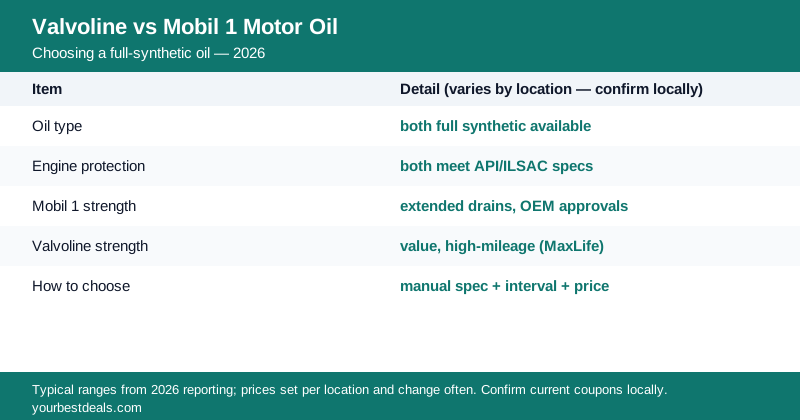
Short answer: both are excellent full-synthetic oils, and either will protect your engine as long as it meets your owner’s manual specification – so this isn’t a case where one brand is “right” and the other “wrong.” The real differences are at the margins. Mobil 1 is often favored for extended drain intervals, premium OEM approvals, and severe-use situations (towing, track, extreme heat). Valvoline offers strong value for routine maintenance, and its MaxLife line is popular for high-mileage engines. Pick by three things: your manual’s required spec (API/ILSAC rating and viscosity), your change interval, and price. Marketing claims of “X times better protection” are contested and shouldn’t drive the decision.
This is one where I tell people to relax – I ran into brand loyalty wars at the counter constantly, and the truth is both are great oils. Here’s the quick verdict, then what actually matters.
Quick verdict: For most drivers on normal intervals, pick whichever meets your spec and is cheaper that week. Lean Mobil 1 if you push extended drains, tow, or want a specific OEM approval; lean Valvoline MaxLife if your engine is high-mileage or you want value.
How they compare
Here’s the head-to-head. Both are quality synthetics; match to your manual’s spec first.
| Factor | Valvoline | Mobil 1 |
|---|---|---|
| Engine protection | Meets API/ILSAC specs | Meets API/ILSAC specs |
| Best known for | Value, high-mileage (MaxLife) | Extended drains, OEM approvals |
| Severe use (tow/track/heat) | Good | Often preferred |
| Price | Usually a bit lower | Usually a bit higher |
| How to choose | Manual spec + your interval + price | |
For where to get it changed: our Valvoline service guide, oil change cost guide, and Jiffy Lube vs Valvoline comparison.
Shop Talk
The thing people get wrong is arguing brand before spec. Open your owner’s manual (or the oil cap) and find two things: the viscosity (like 0W-20) and the required rating/approval (an API SP or ILSAC GF-6 rating, and for some European cars a specific OEM approval like a VW or Mercedes number). Any oil – Valvoline or Mobil 1 – that carries your required viscosity and rating will protect your engine properly. That’s the real decision; the brand is secondary. Once you’re choosing between two oils that both meet your spec, then the tiebreakers are: Mobil 1 if you run extended drain intervals, tow or drive hard, or your automaker specifically calls for a Mobil 1 approval (some do); Valvoline if you want value, or Valvoline MaxLife if your engine is high-mileage (the MaxLife formulation has seal conditioners aimed at older engines). Ignore the “4X better protection” type ad claims – those come from specific lab tests framed for marketing, and independent used-oil analyses show both brands keep wear metals far below any concern. Buy on sale: both go on rebate/sale at parts stores regularly, so the cheaper one that meets your spec is the smart buy. And whatever you pick, change it on your manufacturer’s interval – that matters more than the brand.
Where Drivers Overpay
The overpay here is paying a premium for a brand or a “better protection” claim when a cheaper oil meeting the same spec protects the engine identically. Both brands routinely go on sale and rebate at parts stores, so buying the one that’s discounted that week – as long as it meets your spec – is free money.
The other miss is buying the wrong spec to save a dollar, or chasing extended-drain oil you don’t need. The pattern: match the manual’s viscosity and rating first, then pick the cheaper qualifying oil, and change it on schedule.
The Real Number
Valvoline and Mobil 1 are both excellent full synthetics – either protects your engine as long as it meets your manual’s viscosity and rating. Lean Mobil 1 for extended drains, severe use, or a specific OEM approval; lean Valvoline (or MaxLife for high-mileage) for value. Ignore “X times better” ad claims, match the spec first, then buy whichever qualifying oil is cheaper that week – and change it on schedule, which matters more than the brand.
Frequently Asked Questions
Is Mobil 1 better than Valvoline?
Not in a way that matters for most drivers – both are high-quality full-synthetic oils that meet current industry specifications and protect modern engines well, so neither is categorically “better.” Mobil 1 has a strong reputation and is often chosen for extended drain intervals, premium OEM approvals, and severe-use conditions, and some automakers specifically recommend or factory-fill Mobil 1. Valvoline is equally a major, respected brand, typically offering good value, with its MaxLife line popular for high-mileage engines. Independent used-oil analyses generally show both keeping engine wear well within safe limits, and marketing claims that one is “several times better” than the other come from specific lab tests framed for advertising and are contested, so they shouldn’t drive your choice. The honest answer is that for normal driving on normal intervals, you can’t go wrong with either – pick whichever meets your car’s required specification and is cheaper. Where Mobil 1 may have a slight edge is in extended-drain or severe-use scenarios and specific OEM approvals; where Valvoline shines is value and high-mileage formulations. So rather than “which is better,” ask “which meets my spec and costs less,” and buy that one.
How do I know which oil my car needs?
Check your owner’s manual (or often the oil filler cap and an underhood label), which specifies the two things that actually matter: the oil viscosity grade and the required performance rating or approval. The viscosity is a code like 0W-20, 5W-30, or 5W-40 – use exactly what the manual calls for, since viscosity affects flow, protection, and even fuel economy and warranty compliance. The performance rating is typically an API service category (like API SP) and/or an ILSAC grade (like GF-6) for most cars, while many European vehicles require a specific OEM approval number (such as a VW, BMW, Mercedes, or Porsche specification). Any oil – Valvoline, Mobil 1, or another quality brand – that carries your required viscosity and rating/approval on the bottle is suitable. So the process is: find the viscosity and the required rating in your manual, then buy an oil that matches both. Don’t substitute a different viscosity to save money or because a brand is on sale in another grade, and for European cars especially, confirm the specific OEM approval is listed. Getting the spec right matters far more than the brand; once you’ve matched the spec, you can freely choose between qualifying oils on price. When in doubt, the manual is the authority.
Does the oil brand affect my warranty?
The brand itself generally doesn’t, but using oil that meets the manufacturer’s required specification does matter for warranty compliance – so the key is the spec, not whether it’s Valvoline or Mobil 1. Automakers require that you use oil meeting their stated viscosity and performance standard (and sometimes a specific OEM approval), and they require changes at the specified interval, with records. As long as the oil you use – of any reputable brand – meets that specification, and you change it on schedule and keep receipts, your warranty is protected; you’re not required to use the dealer or a specific brand (U.S. law, via the Magnuson-Moss Warranty Act, generally prevents automakers from voiding your warranty just because you didn’t use their branded oil or their dealer, provided you used qualifying oil properly). Where people get into trouble is using an oil that doesn’t meet the required spec (wrong viscosity or missing a required OEM approval), or skipping documented changes – that can jeopardize a warranty claim if a failure results. So for warranty peace of mind: use any quality oil (Valvoline, Mobil 1, etc.) that meets your manual’s exact specification, change it on time, and keep records. The brand is your choice; the specification and the documented interval are what the warranty actually cares about.
What is Valvoline MaxLife and who is it for?
Valvoline MaxLife is a full-synthetic (also available in synthetic-blend and conventional) oil formulated specifically for higher-mileage engines – generally marketed for vehicles over about 75,000 miles – and it’s one of Valvoline’s distinguishing products in this comparison. The idea is that older engines develop wear and their seals can harden or shrink over time, so MaxLife includes seal conditioners meant to help keep seals pliable and reduce leaks and oil consumption, along with additives aimed at wear and deposit control in aging engines. For a high-mileage car that’s starting to seep a little oil or burn a bit, MaxLife is a popular, reasonably priced choice that still meets the required specifications. Mobil 1 also offers a high-mileage line (Mobil 1 High Mileage), so this isn’t unique to Valvoline, but MaxLife is especially well-known and often good value. If your engine is newer and not consuming oil, you don’t need a high-mileage formulation – standard full synthetic in your spec is fine. For an older, higher-mileage engine, though, a high-mileage oil like MaxLife (or Mobil 1 High Mileage) can be a sensible pick. As always, make sure the high-mileage oil you choose still carries your required viscosity and rating. It’s a targeted product for aging engines, not a universal upgrade.
Can I switch between Valvoline and Mobil 1?
Yes – you can freely switch between Valvoline and Mobil 1 (or any quality brands) from one oil change to the next, as long as each meets your vehicle’s required specification; there’s no harm in alternating brands. Motor oils that meet the same industry specifications are compatible, so switching brands at a normal oil change is completely fine and won’t harm your engine – you’re not “locked in” to the brand you used last time. This is good news for saving money: you can buy whichever qualifying brand is on sale or has a rebate at a given change, alternating as prices dictate, without any downside. The only real cautions are the usual ones: always use the correct viscosity and required rating/approval for your car (don’t switch viscosities to chase a sale), and if you switch between conventional and synthetic, that’s also generally fine but synthetic is preferable if your car requires it. You don’t need to flush the engine or take special steps to change brands. So treat brand as a flexible, price-driven choice at each oil change – Valvoline this time, Mobil 1 next time, whatever meets your spec and costs less – and focus your consistency on changing the oil at the proper interval rather than on brand loyalty. Switching is safe and smart for value.
Are the “X times better protection” claims real?
Those claims come from specific laboratory wear tests framed for marketing, and they’re truly contested, so you shouldn’t base your decision on them. For example, Valvoline has advertised claims like “better wear protection than Mobil 1” based on a particular standardized engine test (such as the Sequence IVA wear test), and such claims are technically tied to that test’s results – but critics and oil-analysis enthusiasts point out that both oils keep wear metals far below any level of concern, so a difference that looks dramatic in a controlled test (“several times less wear”) can be comparing very small numbers that are both well within safe limits. In other words, “4X better” can mean one oil showed, say, 1 part-per-million of a wear metal versus 4 – both trivially low against a pass threshold many times higher. Oil makers on all sides run tests and craft claims that favor their product, so these marketing figures tend to cancel out. The practical takeaway: both Valvoline and Mobil 1 provide excellent, more-than-adequate protection for normal use, and real-world engine longevity depends far more on changing the oil on schedule and using the correct spec than on which top-tier synthetic you chose. Treat the ad claims as marketing, not a buying guide, and decide on spec, suitability, and price.
Which should I buy to save money?
Buy whichever brand – Valvoline or Mobil 1 – meets your car’s required specification and is cheaper at the moment, because both are excellent and routinely go on sale or offer rebates. Since switching brands between changes is harmless as long as each meets your spec, you can let price decide every time: check for sales and mail-in or instant rebates at auto-parts stores (Advance Auto Parts, AutoZone, O’Reilly, Walmart, etc.), which both brands run regularly, and buy the qualifying oil with the best current deal. Valvoline is often priced a bit lower day-to-day, while Mobil 1 frequently has strong rebate promotions that can bring it level or below – so the “cheaper” one varies. If you’re doing the change yourself, buying a 5-quart jug on sale plus a quality filter is the most economical route. If a shop is doing it, you’re usually paying for whatever oil they stock in your spec, though some will use oil you bring. Either way, don’t pay a premium for brand loyalty or marketing claims when a qualifying oil is on sale. The real money-saver, beyond picking the cheaper qualifying oil, is doing the change at the correct interval (not more often than needed with modern synthetics) and, if you’re able, doing it yourself. Match the spec, buy the deal, change on schedule.
Sources
Comparison based on both brands’ published specifications and independent oil-analysis and reporting in November 2026. Always match your vehicle’s owner’s-manual specification; brand marketing claims are contested and not a buying basis.
- MechanicBase – Valvoline vs Mobil 1 differences
- API – engine oil standards and ratings
- ASE – National Institute for Automotive Service Excellence
Related Guides
- Valvoline Coupons & Prices
- Oil Change Cost Guide
- Jiffy Lube vs Valvoline
- Advance Auto Parts Coupons & Services
- Auto Service Coupons Hub

Diane Holcomb spent seven years as a service advisor at multi-brand dealerships in Charlotte, NC, refereeing brand-loyalty arguments at the counter – and learned to redirect them to the only thing that matters: the viscosity and rating in the manual, then whichever qualifying oil is on sale. She drives a 2019 Honda CR-V and a hand-me-down 2007 Toyota Camry, and takes no referral fees or advertising money from any shop or chain.