
Last updated: November 8, 2026 – By Eddie Brennan
November 2026 update: reconfirmed the problem list, cost by bushing type, and the identify-the-part caution.
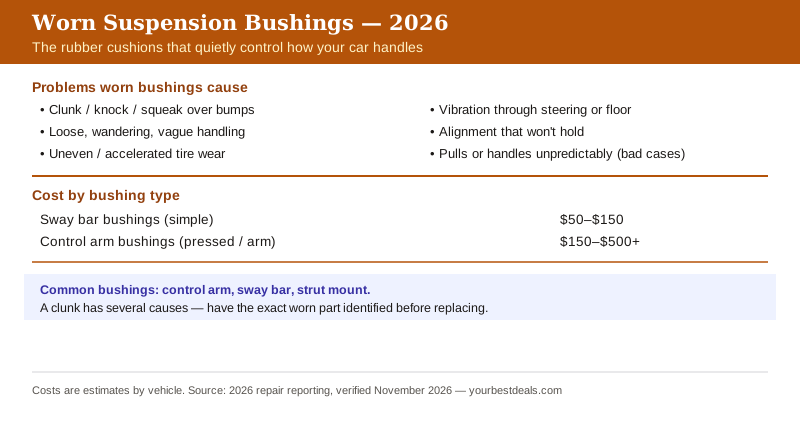
Suspension bushings are the rubber (or polyurethane) cushions at the joints where suspension and steering parts connect, and they quietly control how your car rides and handles. When they crack, dry out, or tear with age, they cause a range of problems: clunking, knocking, or squeaking over bumps; loose, wandering, or vague handling; uneven or accelerated tire wear; vibration through the steering or floor; alignment that won’t hold; and, in bad cases, a car that pulls or handles unpredictably. Common ones include control arm bushings, sway bar bushings, and strut mounts. Cost varies a lot by which bushing: a simple sway bar bushing can be $50 to $150, while control arm bushings that must be pressed in (or where the whole control arm is replaced) run about $150 to $500 or more per side. Because a clunk has several possible causes, the exact worn part should be identified before replacing.
Bushings are the unsung parts of the suspension – nobody thinks about them until the car starts clunking or handling loosely, and by then they’ve usually been degrading for a while. Let me explain what problems they cause, how a tech identifies a worn bushing versus another part, and what the range of repair costs looks like.
The problems worn bushings cause
As a bushing hardens, cracks, or tears, the joint it cushions develops play and lets metal move where it shouldn’t, which creates both noise and handling problems. Clunks, knocks, or squeaks over bumps as the loose joint moves. Loose, wandering, or vague handling, since the suspension geometry shifts slightly under load instead of staying planted. Uneven or accelerated tire wear, because worn bushings can let the wheels move out of their proper alignment. Vibration through the steering or floor. Alignment that won’t hold – a telltale sign, because if the bushings are worn the wheels can’t stay in their aligned position. Unpredictable handling in bad cases. Our clunking-over-bumps guide and suspension guide cover related symptoms.
What it costs
Here’s the price picture. These are estimated ranges that vary widely by which bushing and vehicle.
| Bushing type | Cost | Notes |
|---|---|---|
| Sway bar bushings (simple) | $50–$150 | Bolt-on, cheaper |
| Control arm bushings (pressed) | $150–$500+ | Pressed in; labor-intensive |
| Whole control arm (if replaced) | $150–$500+ | Sometimes easier than pressing |
| Strut mount | varies | Depends on vehicle |
The cost swing is huge because it depends on the bushing. Simple bolt-on bushings (like sway bar bushings) are cheap. Bushings pressed into a control arm require pressing the old one out and the new one in, which is labor-intensive – and sometimes it’s actually cheaper or more practical to replace the entire control arm (which comes with new bushings and ball joint) than to press individual bushings. A shop can advise which approach fits your vehicle. Our estimator hub has related suspension costs.
Shop Talk
Two useful things here. First, the alignment-won’t-hold clue is one of the best tells for worn bushings that people overlook. If you got an alignment recently and the car has already drifted back out of spec (pulling again, uneven wear returning), worn bushings are a strong suspect – because if the rubber can’t hold the suspension arm in position, no alignment will stay put. So if alignments don’t “stick,” ask the shop to check the bushings, not just re-align. Second, on the pressed-in control arm bushings, ask your shop to price it both ways: pressing new bushings into your existing arm versus replacing the whole control arm assembly. On a lot of modern cars the complete arm (with fresh bushings and ball joint already installed) is close in price to the labor of pressing bushings, and it gives you new ball joints too – often the better value. And the diagnostic discipline that saves money: a clunk or loose feel can be bushings, but also ball joints, sway bar links, tie rods, or struts, so have the specific worn part identified with the wheels hanging before authorizing work. Don’t pay to replace all the bushings if one worn link or ball joint was the actual noise.
What Gets Misdiagnosed
The main pitfall is lumping every clunk or loose-handling complaint onto “bushings” (or onto any single part) without identifying the specific worn component. Bushings, ball joints, sway bar links, tie rods, and struts all produce overlapping noises and vague handling, so a proper inspection with the wheels hanging pinpoints which joint has play rather than guessing. Replacing bushings when a sway bar link or ball joint was the real noise leaves the problem unfixed.
The flip side is missing worn bushings as the reason an alignment won’t hold. If a car keeps drifting out of alignment or wearing tires unevenly shortly after an alignment, the bushings may be too worn to keep the suspension in position – and simply re-aligning without addressing them wastes the alignment. So the pattern is: identify the specific worn part for a noise, and suspect bushings specifically when alignments don’t stay put or tire wear returns quickly. Price pressed bushings against a full control arm, and fix the actual worn component rather than replacing parts broadly.
The Real Number
Worn suspension bushings cause clunks and squeaks over bumps, vague or wandering handling, uneven tire wear, and – a key tell – alignment that won’t hold. Cost swings widely by bushing: simple sway bar bushings are $50 to $150, while pressed-in control arm bushings run $150 to $500+ (sometimes it’s better value to replace the whole control arm). Have the specific worn part identified with the wheels hanging before replacing, and suspect bushings when alignments don’t stay put.
Frequently Asked Questions
What problems do worn suspension bushings cause?
Worn bushings cause clunking, knocking, or squeaking over bumps; loose, wandering, or vague handling; uneven or accelerated tire wear; vibration through the steering or floor; alignment that won’t hold; and, in bad cases, unpredictable handling. They happen because the rubber cushion at a suspension joint has cracked, dried out, or torn, letting the joint develop play. Common culprits are control arm bushings, sway bar bushings, and strut mounts. Because these symptoms overlap with other worn suspension parts, the specific bushing should be confirmed before replacing.
How much does it cost to replace suspension bushings?
It varies widely by which bushing. Simple bolt-on bushings like sway bar bushings run about $50 to $150, while control arm bushings that must be pressed in are labor-intensive at about $150 to $500 or more per side. Sometimes replacing the entire control arm (which includes new bushings and a ball joint) is close in price to pressing bushings and is the better value. Strut mounts vary by vehicle. These are estimates that vary a lot by vehicle and bushing. Ask your shop to price pressed bushings against a full control arm.
Can worn bushings cause an alignment to not hold?
Yes, and it’s one of the clearest signs of worn bushings that people overlook. Alignment settings depend on the suspension arms staying in their proper position, which the bushings hold. If a bushing is too worn, the arm can shift under load, so the wheels drift out of alignment shortly after being set – the car pulls again or tire wear returns. So if an alignment doesn’t “stick,” ask the shop to check the bushings rather than just re-aligning, because re-aligning worn-out bushings won’t stay put and wastes the service.
Are worn bushings dangerous to drive on?
Mildly worn bushings are more of a comfort, noise, and tire-wear issue than an immediate safety emergency – the car still drives, though it may clunk and handle vaguely. But severely worn bushings can allow enough suspension movement to affect handling and tire wear meaningfully, and worn bushings often accompany other worn suspension parts (like ball joints or tie rods) that are safety items. So while bushings alone usually aren’t urgent, the loose handling and clunks they cause warrant a front-end inspection to rule out anything safety-critical and to prevent uneven tire wear.
How do I know if it’s bushings or another suspension part?
You often can’t tell from the driver’s seat alone, because bushings, ball joints, sway bar links, tie rods, and struts produce overlapping clunks and loose handling. A technician confirms it with the car raised and the wheels hanging, checking each joint for play by shaking components and using a pry bar to reveal movement in bushings. The alignment-won’t-hold clue points specifically toward bushings. Rather than guessing, get the specific worn part identified during a front-end inspection so you replace the actual culprit instead of a broad set of parts.
How long do suspension bushings last?
They’re a wear item with no fixed interval, and life depends heavily on conditions – heat, cold, road salt, potholes, and age all degrade the rubber. Many last well over 100,000 miles, while harsh conditions can wear them sooner. Polyurethane bushings (aftermarket) can last longer than rubber but transmit more noise and vibration. They’re not a scheduled maintenance part; you replace them when they crack or wear and cause symptoms. Having them checked during suspension inspections, especially if alignments won’t hold or you hear clunks, is the practical approach.
Should I replace bushings with rubber or polyurethane?
For most everyday drivers, standard rubber bushings (OEM-style) are the right choice – they ride quietly and comfortably and match how the car was designed. Polyurethane bushings are firmer and more durable and are popular for performance or heavy-duty use, but they transmit more road noise, vibration, and harshness into the cabin, which many drivers find unpleasant on a daily car. So unless you specifically want firmer handling and accept the harsher ride, rubber is usually the better pick for a normal commuter. Match the bushing type to how you actually use the vehicle.
Sources
Problem list reflects standard suspension diagnostics; cost ranges verified against 2026 repair pricing in November 2026. Dollar amounts are estimates that vary widely by bushing and vehicle.
- ASE – National Institute for Automotive Service Excellence
- RepairPal – suspension repair estimates
- NHTSA – vehicle safety
Related Guides
- What Causes a Clunking Noise Over Bumps?
- Bad Sway Bar Link Symptoms
- Bad Tie Rod Symptoms
- Suspension & Steering Guide
- Car Repair Cost Estimator

Eddie Brennan is an ASE Master Certified technician (A4 Suspension & Steering among his certs) who spent 11 years diagnosing worn bushings and front-end play at an independent shop in Columbus, OH before a back injury moved him into writing full-time. He drives a 2015 Subaru Outback with over 250,000 miles and a 2020 Ford F-150, and takes no referral fees or advertising money from any shop or chain.