
Last updated: November 6, 2026 – By Diane Holcomb
November 2026 update: reconfirmed U-joint pricing and the joint-vs-driveshaft point.
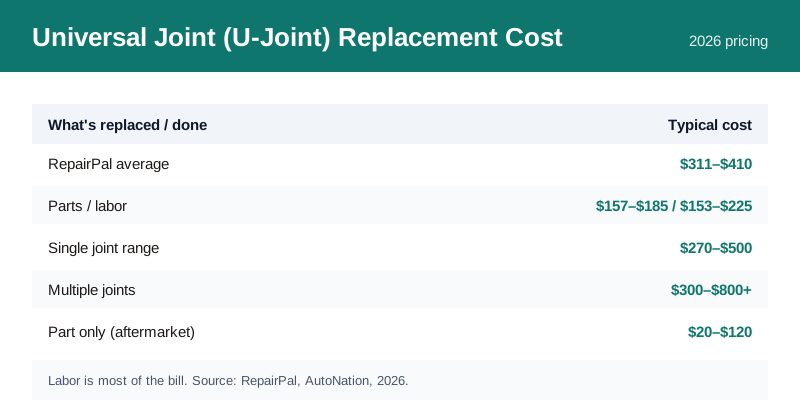
A single universal (U-)joint replacement averages about $311 to $410 (RepairPal), with parts at roughly $157 to $185 and labor $153 to $225. The single-joint range runs about $270 to $500, and replacing several at once is $300 to $800 or more. The part itself is cheap – just $20 to $120 – so, like many driveline jobs, you’re mostly paying for labor. A U-joint is the cross-shaped joint that connects sections of the driveshaft and lets it flex as the suspension moves up and down while still transmitting power. They’re found on rear- and all-wheel-drive vehicles and trucks. A worn U-joint causes a clunk when you take off or shift into gear (from play in the joint), a vibration that grows with speed, and sometimes a squeak. The good news: on most vehicles you replace just the worn joint, not the whole driveshaft.
That clunk on takeoff is the classic warning, and this is usually a joint job, not a driveshaft job. Let me break it down.
What you’ll actually pay
Here’s the picture. These are estimates that vary by vehicle and shop.
| Item | Cost | Notes |
|---|---|---|
| Single joint (RepairPal avg) | $311–$410 | Parts + labor |
| Parts / labor | $157–$185 / $153–$225 | Labor-heavy |
| Single-joint range | $270–$500 | By vehicle |
| Multiple joints | $300–$800+ | Several at once |
U-joints are part of the driveshaft; our drive shaft guide and CV joint guide cover the related driveline parts (CV joints are the front-drive equivalent).
Shop Talk
The telltale sign of a worn U-joint is a clunk – you feel or hear it when you let off and get back on the throttle, or when you shift from park to drive or drive to reverse. That’s play in the worn joint taking up slack. As it gets worse you’ll get a vibration that increases with speed and sometimes a squeak (a dry joint). Here’s the money part: the U-joint itself is cheap, often $20 to $80 for a decent aftermarket one, so you’re paying for the labor to press the old joint out and the new one in – and on most trucks and rear-drive cars you replace just the worn joint, not the whole driveshaft. If a shop quotes you a complete driveshaft for a clunk, ask whether your driveshaft has serviceable U-joints that can be replaced individually; on many vehicles they do. Two cautions. One, don’t ignore a clunking, vibrating U-joint – if it fails completely, the driveshaft can drop or whip at speed, which is dangerous and can damage the underbody, so this is a fix-it-soon item, not a wait-and-see one. Two, if you’ve got multiple worn joints or the driveshaft’s already out, doing them together saves repeat labor. And after the work, the driveshaft should run smooth – a lingering vibration means it may need balancing.
Where Drivers Overpay
The overpay is being quoted a whole driveshaft for a clunk when a single serviceable U-joint would fix it. The joint is a $20–$120 part; the shaft is far more. Asking whether your driveshaft has replaceable U-joints – most trucks and rear-drive cars do – is the key save.
The flip side is safety, not savings: ignoring a clunking, vibrating U-joint risks it failing at speed, which is dangerous and can damage more. The pattern: catch the clunk early, replace just the worn joint (bundling several if the shaft’s already out), and make sure the shaft runs smooth (balanced) afterward.
The Real Number
A single U-joint is $311 to $410 (RepairPal), range $270 to $500 – the joint itself is only $20 to $120, the rest is labor. A clunk on takeoff or when shifting into gear is the warning. On most trucks and rear-drive cars you replace just the worn joint, not the whole driveshaft, so ask before accepting a full-shaft quote. Don’t ride it out – a failed U-joint at speed is dangerous.
Frequently Asked Questions
How much does it cost to replace a U-joint?
A single universal joint replacement averages about $311 to $410 (per RepairPal), with parts at roughly $157 to $185 and labor $153 to $225. The broader single-joint range is about $270 to $500 depending on the vehicle, and replacing several joints at once runs $300 to $800 or more. The U-joint part itself is inexpensive – about $20 to $120 – so most of the cost is labor to press the old joint out and the new one in. These are estimates that vary by vehicle and shop. Heavier trucks or jobs with seized, rusted parts cost more. Because the part is cheap and you usually replace just the worn joint (not the whole driveshaft), this is a relatively affordable driveline repair when caught in time.
What does a U-joint do?
A universal joint (U-joint) is the cross-shaped, pivoting joint that connects sections of the driveshaft and allows it to transmit power while flexing. On a rear- or all-wheel-drive vehicle, the driveshaft runs from the transmission to the axle, and because the axle moves up and down with the suspension while the transmission stays fixed, the driveshaft needs joints that let it bend and change angle while still spinning and delivering power. U-joints provide that. There’s usually one at each end of the driveshaft (and more on a two-piece shaft). They contain needle bearings packed with grease. Over time and miles, those bearings wear and the grease dries out, creating play and the characteristic clunk. They’re the rear-drive equivalent of the CV joints on front-wheel-drive cars.
What are the symptoms of a bad U-joint?
The classic symptom is a clunk – felt or heard when you accelerate from a stop, let off and reapply the throttle, or shift between drive and reverse – caused by play in the worn joint. As the joint deteriorates, you’ll often get a vibration that increases with vehicle speed, and sometimes a squeaking noise (especially at low speed) from a dry, worn joint. You might also notice a rust-colored dust around the joint, a sign the seals have failed and the bearings are wearing. Because a clunk and vibration can also come from other driveline parts, a shop confirms it’s the U-joint. Since a failed U-joint can let the driveshaft drop, these symptoms warrant prompt attention rather than ignoring them until something lets go.
Can I replace just the U-joint instead of the whole driveshaft?
On most trucks and rear/all-wheel-drive cars, yes – and that’s the money-saving point. The U-joints on these vehicles are typically serviceable: a shop can press the old joint out of the driveshaft yoke and press a new one in, without replacing the whole shaft, for a fraction of the cost. You’d only need a full driveshaft if the shaft itself is bent or damaged, or if your vehicle uses sealed, non-serviceable joints that aren’t sold separately (some do). So if you’re quoted a complete driveshaft for a clunking U-joint, it’s worth asking whether your driveshaft has replaceable U-joints – many do. Replacing just the worn joint is the standard, economical repair on vehicles with serviceable U-joints. See our drive shaft guide for when a full shaft is actually needed.
Is it safe to drive with a bad U-joint?
It’s not something to ignore – a failing U-joint is one of the more serious driveline issues to keep driving on. A worn joint has play that only worsens, and if it fails completely, the driveshaft can drop at one end or whip around at speed, which can damage the underbody, lock up the driveline, or cause a loss of control. So a clunking, vibrating U-joint is a fix-it-soon item, not a wait-and-see one. A mild early clunk isn’t an instant emergency, but once it’s clearly worn and vibrating, you should get it replaced promptly rather than risk a failure on the highway. If you feel a growing vibration or hear a loud clunk from underneath, have it inspected before driving much further. The repair is far cheaper and safer than the breakdown.
Why does the U-joint clunk when I shift into gear?
Because a worn U-joint has play (slack) in its bearings. When you shift from park to drive, drive to reverse, or get on and off the throttle, the driveline loads and unloads, and that slack gets taken up suddenly – producing the clunk you feel or hear. A healthy U-joint is tight with no play, so it transmits that load smoothly and silently. As the needle bearings inside the joint wear and the grease dries out, the play develops and grows, and the clunk becomes more noticeable. This is actually a useful early-warning symptom: the clunk tells you the joint is wearing before it fails completely. So a new clunk on takeoff or when shifting gears is worth having checked, because it often means a U-joint (or another driveline part with play) is on its way out.
Should the driveshaft be balanced after U-joint replacement?
The driveshaft should run smoothly afterward, and if it doesn’t, balancing may be needed. A driveshaft spins at high speed, so it must be in balance to avoid vibration. When U-joints are pressed in correctly, the shaft usually retains its balance and runs smooth. But if you notice a vibration after the work that wasn’t there before (or the old vibration persists), the shaft may need to be checked and balanced, or a joint may not have seated properly. A quality repair includes making sure the shaft runs true. So while routine U-joint replacement doesn’t always require a separate balancing step, the result should be a smooth-running driveshaft – and a lingering vibration is a reason to have it rechecked. Ask the shop to confirm the shaft runs smooth after the joint work.
Sources
Price ranges verified against 2026 U-joint pricing in November 2026. Dollar amounts are estimates that vary by vehicle and shop.
- RepairPal – U-joint replacement cost
- AutoNation Mobile Service – U-joint replacement cost
- ASE – National Institute for Automotive Service Excellence
Related Guides
- Drive Shaft Repair Cost
- CV Joint Replacement Cost
- CV Axle Replacement Cost
- Rear Differential Replacement Cost
- Car Repair Cost Estimator

Diane Holcomb spent seven years as a service advisor at multi-brand dealerships in Charlotte, NC, where a “clunk when I shift into drive” on a truck was usually a cheap U-joint, not the whole driveshaft the customer feared. She drives a 2019 Honda CR-V and a hand-me-down 2007 Toyota Camry, and takes no referral fees or advertising money from any shop or chain.