
Last updated: November 7, 2026 – By Diane Holcomb
November 2026 update: reconfirmed battery pricing and the federal 8-year warranty point.
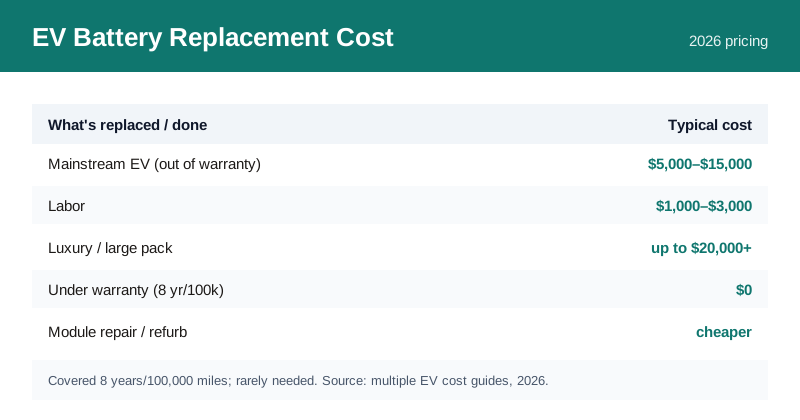
Replacing a mainstream EV battery pack out of warranty runs about $5,000 to $15,000, including labor of roughly $1,000 to $3,000. Luxury EVs and very large packs can run $20,000 or more. These are estimates that vary by make and pack size. The single most important fact: by federal rule, EV batteries carry at least an 8-year / 100,000-mile warranty (longer in some states and on some makes), so the vast majority of owners never pay this out of pocket. And when a pack does develop a fault, repairing or replacing individual modules, or buying a refurbished pack, is often far cheaper than a full new one. The battery is the large, floor-mounted pack that powers the electric motor – full replacement is rare, not routine.
The big scary number is real, but it’s also the exception, not the rule – most owners are covered, and even a failure doesn’t always mean a whole new pack. Let me break it down.
What you’ll actually pay
Here’s the picture. These are estimates that vary by make and pack size.
| Scenario | Cost | Notes |
|---|---|---|
| Under warranty | $0 | 8 yr / 100k min |
| Mainstream pack (out of warranty) | $5,000–$15,000 | Incl. labor |
| Luxury / large pack | $20,000+ | Higher |
| Module repair / refurb | often far less | Partial fix |
Battery costs vary across electric vehicles. For related figures, see our Tesla battery guide and Tesla maintenance guide.
Shop Talk
Before anyone quotes you a five-figure battery, two things usually matter more than the price. First: check your warranty. Federal law requires EV batteries to be warranted at least 8 years or 100,000 miles, and that warranty covers failure and typically capacity dropping below a threshold (often around 70%). Many owners who think they need a new battery are actually still covered. Second: a battery “problem” often isn’t the whole pack. These packs are built from many modules (and cells); frequently a single module or the battery management system is the fault, and replacing that one part – or having a specialist rebuild the pack – costs a fraction of a brand-new pack. Independent EV battery shops and refurbished/remanufactured packs are a growing, cheaper alternative to a dealer’s new-pack price. One more reassurance: real-world data shows modern EV packs are lasting far longer than people feared – gradual range loss over many years is normal, outright failure is uncommon, and most packs outlast the typical ownership period. So if you’re shopping a used EV, ask for a battery health report rather than fearing the sticker number. The scary figure is real but rare, and there are usually cheaper paths than a full new pack.
Where Drivers Overpay
The first mistake is paying at all when the warranty would have covered it – the federal 8-year/100,000-mile minimum (and capacity coverage) catches far more failures than owners realize, so checking it comes before any quote.
The second is assuming a fault means a whole new pack. Packs are modular, so a single bad module, a management-system issue, or a refurbished pack from an independent EV specialist often costs a fraction of a dealer’s new-pack price. The pattern: confirm warranty coverage first, get the fault diagnosed to the module level, and price refurbished or module-level repair against a full replacement.
The Real Number
A full out-of-warranty EV battery runs about $5,000 to $15,000 on mainstream models (labor $1,000 to $3,000) and $20,000+ on luxury EVs – but by federal rule the pack is warranted at least 8 years/100,000 miles, so most owners never pay it. Even a real fault is often one module or the management system, not the whole pack, and refurbished packs cost far less. Check the warranty and get a module-level diagnosis before accepting a new-pack quote.
Frequently Asked Questions
How much does it cost to replace an EV battery?
For a mainstream electric vehicle out of warranty, a full battery pack replacement runs about $5,000 to $15,000, which includes labor of roughly $1,000 to $3,000. Luxury EVs and models with very large packs can run $20,000 or more. These are estimates that vary widely by make, pack size, and whether you use a dealer, an independent EV specialist, or a refurbished pack. But the number most owners actually pay is $0, because federal rules require EV batteries to be warranted for at least 8 years or 100,000 miles, and a genuine failure within that window is covered. Even out of warranty, a full new pack often isn’t necessary – many issues are a single module or the battery management system, which costs far less to fix. So while the worst-case figure is high, it’s uncommon, and there are usually cheaper paths. For the Tesla-specific picture, see our Tesla battery replacement guide.
Are EV batteries covered under warranty?
Yes – and this is the key fact that makes the scary replacement number irrelevant for most owners. Federal law in the U.S. requires manufacturers to warranty EV batteries for a minimum of 8 years or 100,000 miles, whichever comes first. Some states (notably California and the states following its rules) and some manufacturers extend this further, and certain makes offer 10 years or 150,000 miles. Importantly, these warranties typically cover not just outright failure but also excessive capacity loss – if the battery degrades below a specified threshold (often around 70% of original capacity) within the warranty period, it’s usually covered. So a battery that fails or loses too much range while under warranty gets repaired or replaced at no cost to you. This is why, in practice, very few owners ever pay out of pocket for a battery. If you own or are buying an EV, check the specific battery warranty terms for that make and model, and confirm how much coverage remains based on age and mileage. The warranty, far more than the sticker price, is what determines your real exposure.
How long do EV batteries actually last?
Much longer than many people fear – modern EV battery packs are generally lasting well beyond their warranty periods, with gradual range loss rather than sudden failure being the norm. Real-world data and studies increasingly show that packs commonly retain a large majority of their capacity after 100,000+ miles and many years, and that outright pack failure is uncommon. A typical EV battery degrades slowly, losing a small percentage of range per year, so after a decade you might have somewhat less range than when new but a perfectly usable car. Battery life depends on factors you partly control: frequent DC fast charging, routinely charging to 100% or draining to near 0%, and exposure to extreme heat all accelerate degradation, while moderate charging habits (keeping it roughly 20–80% for daily use) and climate control help longevity. The upshot is that for most owners, the battery will outlast their ownership of the car, and the dreaded replacement is a rare event rather than an expected maintenance item. If you’re buying used, a battery health or state-of-health report is the best way to judge a specific pack’s condition.
Can you replace just part of an EV battery?
Often, yes – and it can save a great deal of money compared to a full pack. EV battery packs are built from many individual modules, each containing multiple cells, plus a battery management system that monitors and controls them. When a pack develops a fault, frequently the problem is localized: a single failed module, a bad cell group, or a management-system issue, rather than the entire pack being dead. In those cases, a dealer or independent EV battery specialist can sometimes replace just the affected module(s) or component, which costs a fraction of a complete new pack. This module-level repair is becoming more common as the EV fleet ages and independent specialists emerge. However, it depends on the vehicle – some manufacturers design packs that are difficult to service at the module level, and some dealers default to full-pack replacement. The best approach when facing a battery issue is to get a proper diagnosis that identifies exactly what failed, then ask whether a module repair or a refurbished/remanufactured pack is an option before committing to a full new pack. Shopping that around to an EV specialist can reveal much cheaper solutions.
Why are EV batteries so expensive to replace?
An EV battery is by far the most expensive single component in the car, for a few reasons. It’s a large, complex assembly – hundreds or thousands of cells organized into modules, with cooling systems, structural housing, wiring, and a sophisticated battery management system – and it stores a huge amount of energy. The raw materials (lithium, nickel, cobalt, and others) are costly, and manufacturing a pack to automotive safety and durability standards is expensive. On top of the part cost, replacement labor is significant ($1,000 to $3,000) because the pack is large, heavy, and integrated into the vehicle’s floor structure, often requiring special equipment and safety procedures to handle high-voltage components. That said, battery costs have been falling steadily as production scales and technology improves, so replacement prices are trending down over time, and the growth of refurbished packs and module-level repair is creating cheaper alternatives to a dealer’s new-pack price. And again, the high cost is largely academic for owners within the long federal warranty. The expense reflects that the battery essentially is the powertrain and fuel tank of the car combined, so it carries the value those represent in a gas car – but it’s a part most drivers will never need to buy.
Does replacing an EV battery make financial sense on an old EV?
It depends on the car’s value and the replacement cost, and sometimes the honest answer is no – which is worth understanding before you’re in that spot. If an out-of-warranty battery fails on an older, lower-value EV, a $5,000 to $15,000 replacement can approach or exceed what the car is worth, making it potentially uneconomical, similar to a major engine or transmission failure totaling an older gas car. In those cases, owners weigh a refurbished or module-level repair (much cheaper) against the car’s value, or may decide to sell or retire the vehicle. However, several things soften this: battery failures on modern EVs are uncommon within a typical ownership period, refurbished packs and module repairs are increasingly available at lower cost, and as the EV market matures, more repair options keep emerging. For a newer or higher-value EV, replacement clearly makes sense; for an old, cheap one, a full new pack may not. The practical takeaway: if you’re facing this, get the fault diagnosed precisely, price out refurbished and module-repair options (not just a dealer new pack), and compare that against the car’s market value before deciding. For most owners, though, this decision never arrives, because the pack outlasts their time with the car.
How can I make my EV battery last longer?
Good charging habits are the main lever, and they’re simple to follow. For daily use, keeping the battery roughly between 20% and 80% rather than routinely charging to a full 100% or draining to near empty reduces stress on the cells and slows degradation – many EVs let you set a charge limit for this. Save 100% charges for when you actually need the full range (like a road trip). Rely mostly on slower Level 2 (home/AC) charging and limit frequent DC fast charging, since repeated fast charging generates heat that ages the battery faster. Try to avoid leaving the car sitting at a very high or very low state of charge for long periods, and park in moderate temperatures when possible, since extreme heat is hard on batteries (most EVs have thermal management that helps, but shade and garages still assist). Gentle driving and not constantly running the pack hot also help marginally. None of this requires obsessive management – modern EVs are designed to protect their batteries, and normal use is fine – but moderate charging habits meaningfully extend pack life and preserve range over the years. Following them is free and helps ensure the battery easily outlasts your ownership, keeping that expensive replacement firmly in the “never needed” column.
Sources
Figures verified against 2026 EV battery and warranty reporting in November 2026. Dollar amounts are estimates that vary by make and pack size.
- FuelEconomy.gov – EV batteries and warranties
- Jerry – EV battery replacement cost
- ASE – National Institute for Automotive Service Excellence
Related Guides
- Tesla Battery Replacement Cost
- Tesla Maintenance Cost
- EV Charger Installation Cost
- Car Repair Cost Estimator

Diane Holcomb spent seven years as a service advisor at multi-brand dealerships in Charlotte, NC, where the scariest-sounding number on any EV question was the battery – and she learned that checking the warranty and the module-level diagnosis almost always deflated it. She drives a 2019 Honda CR-V and a hand-me-down 2007 Toyota Camry, and takes no referral fees or advertising money from any shop or chain.