
Last updated: November 9, 2026 – By Diane Holcomb
November 2026 update: reconfirmed dyno tune pricing and the performance-not-maintenance distinction.
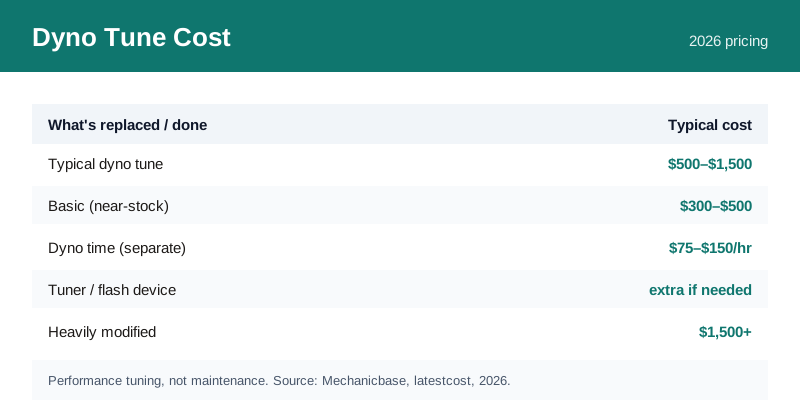
A typical dyno tune runs about $500 to $1,500. A basic near-stock tune is closer to $300 to $500, while a heavily modified build runs $1,500 and up. Dyno time is often billed separately at roughly $75 to $150 per hour, and the tuner software or flash device can be an added cost. These are estimates that vary by shop and build. A dyno tune uses a dynamometer – a machine that measures the engine’s power output while the car runs in place – as a tuner adjusts the engine’s computer (fuel delivery, ignition timing, boost on turbo cars) to make more power and improve drivability. One thing to be clear about up front: this is a performance upgrade, not routine maintenance. It’s for people with modified or performance vehicles, not something a stock daily driver needs.
Because a dyno tune is a performance service rather than a repair, the price depends almost entirely on how modified your car is and how much work the tune involves. Let me break it down.
What you’ll actually pay
Here’s the picture. These are estimates that vary by shop and build.
| Type | Cost | Notes |
|---|---|---|
| Basic / near-stock tune | $300–$500 | Bolt-ons |
| Typical dyno tune | $500–$1,500 | Most builds |
| Heavily modified build | $1,500+ | Forced induction |
| Dyno time | $75–$150/hr | Sometimes separate |
Tuning also relates to performance upgrades such as cold-air intakes and turbochargers. See our car tuning cost guide for the broader pricing picture.
Shop Talk
First, know whether you even need a dyno tune – most drivers don’t. If your car is stock, it came tuned from the factory and a dyno tune won’t do much; this service is for cars with modifications (forced induction, cams, intake/exhaust, E85) that change how the engine breathes and need the computer re-calibrated to run right and safely. What you’re paying for is a skilled tuner’s time on a dynamometer: they make pulls, read the data (air-fuel ratio, knock, power), and adjust the ECU map in real time, repeating until the car makes clean, reliable power. That’s why the cost tracks hours and complexity: a simple bolt-on car might take an hour or two ($300 to $500), while a built turbo car with lots of variables takes much longer ($1,500+). A few things that affect the bill: a “custom dyno tune” (tailored to your exact car on the dyno) costs more than a generic “off-the-shelf” or “canned” tune or a mail-order flash, but it’s safer and better for modified engines. The tuning device or software license (like a handheld flasher or a licensed tune) may be an extra line. And the dyno rental/time is sometimes bundled, sometimes billed hourly on top – ask. Pick the tuner by reputation and experience with your platform, not price alone: a cheap tune that runs the engine lean can cost you an engine, which is far more expensive than the tune.
Where Drivers Overpay
The worst “overpay” here isn’t the tune price – it’s a bad tune. A cheap tuner who runs the engine lean to chase big numbers can destroy a motor that costs many times the tune to replace, so paying for an experienced tuner on your platform is the real value call, not finding the lowest quote.
The other spending question is whether you need a custom dyno tune at all: a mild bolt-on car may be fine with a cheaper off-the-shelf flash, while a built engine truly needs the custom dyno work. The pattern: match the tune type to the build, confirm whether dyno time and the tuner device are included, and choose the tuner by reputation.
The Real Number
A dyno tune runs about $500 to $1,500 – a basic near-stock tune closer to $300 to $500, a heavily modified build $1,500 and up, with dyno time sometimes billed separately at $75 to $150 an hour. This is a performance upgrade, not maintenance: a stock daily driver doesn’t need one. Match the tune type to your build, confirm whether dyno time and the tuner device are included, and choose the tuner by reputation – a cheap lean tune can cost you the engine.
Frequently Asked Questions
How much does a dyno tune cost?
A typical dyno tune runs about $500 to $1,500, depending heavily on your car and how modified it is. A basic tune for a near-stock car with simple bolt-on mods is closer to $300 to $500, while a heavily modified build – especially with forced induction (turbo or supercharger) and many variables – runs $1,500 and up. Dyno time itself is sometimes billed separately at roughly $75 to $150 per hour, and the tuning software or flash device can be an additional cost. These are estimates that vary by shop, region, and the complexity of your build. The price essentially tracks the tuner’s time and skill: more modifications mean more hours on the dyno dialing in the engine map safely. Because a dyno tune is a performance service rather than routine maintenance, there’s no “standard” price the way there is for an oil change – get a quote from a reputable tuner who knows your platform, and clarify whether dyno time and any device/license are included. For the broader category, see our car tuning guide.
What exactly is a dyno tune?
A dyno tune is the process of optimizing your engine’s computer settings while the car runs on a dynamometer – a machine that measures the engine’s actual power output (and often air-fuel ratio and other data) as the wheels or engine spin under controlled load. The car is strapped down on the dyno’s rollers (or connected to an engine dyno), and a tuner runs the engine through its rev range making “pulls” while watching real-time data. Based on what the dyno shows, the tuner adjusts the engine control unit (ECU) – fuel delivery, ignition timing, and on boosted cars the boost levels – to make the engine produce clean, reliable power and run smoothly, without dangerous conditions like running too lean or knocking. It’s iterative: pull, read data, adjust, repeat, until the map is dialed in. The dyno provides the hard measurements that make this precise and safe, versus guessing or tuning only on the street. The result is a calibration tailored to your specific engine and its modifications. This is why a custom dyno tune is valued for modified cars – it matches the computer to the hardware for the best, safest results.
Does a stock car need a dyno tune?
No – a stock, unmodified car does not need a dyno tune, and this is the most important thing to understand before spending money. When your car left the factory, the manufacturer already tuned the engine’s computer extensively for a good balance of power, efficiency, emissions, and reliability on that exact hardware. A dyno tune on a bone-stock engine has little to work with and typically yields minimal gains, so it’s generally not worth the cost. Dyno tuning exists for cars that have been modified in ways that change how the engine breathes or runs – adding a turbo or supercharger, cams, a bigger intake or exhaust, running E85 or different fuel, or other performance parts – because those changes make the factory tune no longer optimal (or even unsafe), and a custom tune re-calibrates the computer to match the new hardware. So if you’re driving a normal stock vehicle for commuting, you don’t need this service. If you’ve modified your engine for performance, that’s when a dyno tune makes sense to get the most out of (and protect) your build. Save your money if the car’s stock; invest in a quality tune if it’s modified.
What’s the difference between a custom tune and an off-the-shelf tune?
They’re two approaches at different price and precision levels. An off-the-shelf tune (also called a “canned,” “generic,” or “mail-order” tune) is a pre-made calibration – often loaded via a handheld flash device – designed for a specific car and a common combination of mods. It’s cheaper and convenient (you flash it yourself), and it’s fine for mild, well-known setups where the tune closely matches your actual configuration. A custom dyno tune, by contrast, is created specifically for your individual car on the dyno, accounting for your exact mods, fuel, altitude, and even the engine’s particular behavior. It costs more because it’s a tuner’s hands-on time, but it’s safer and more optimized for anything beyond basic bolt-ons – especially boosted or heavily modified engines, where a generic tune could be too aggressive or too conservative for your specific combination. The rule of thumb: mild mods on a common platform may do fine with a quality off-the-shelf tune, while significant or unusual builds warrant a custom dyno tune for the best, safest result. Running a generic tune on a seriously modified engine is where people get into trouble, so match the tune type to how far your build deviates from a known baseline.
Is a dyno tune worth it?
For a modified performance car, usually yes – for a stock daily driver, usually no, so it depends entirely on your situation and goals. If you’ve added performance modifications, a custom dyno tune is often the single best way to realize the gains those parts can offer, since it re-calibrates the engine to actually use the new hardware; it also improves drivability (throttle response, smoothness) and, crucially, ensures the engine runs safely under the new conditions rather than lean or knocking. In that context, the $500 to $1,500 is well spent and can protect a much more expensive engine. If your car is stock, a dyno tune offers little benefit and isn’t worth the cost, since the factory tune is already well-optimized. There’s also a middle ground: some people get a dyno tune mainly for a baseline power measurement or minor refinement, which is more of a want than a need. The honest answer is that a dyno tune’s value is tied to modifications – it’s worth it to properly finish and protect a performance build, and not worth it on an unmodified car. Decide based on whether your engine has changes that the factory tune no longer suits.
Can a bad tune damage my engine?
Yes – and this is exactly why you shouldn’t choose a tuner on price alone. The engine’s computer controls fuel delivery and ignition timing, and a tune that’s too aggressive or poorly done can put the engine in dangerous conditions: running too lean (not enough fuel for the air), too much ignition timing, or too much boost can cause detonation (knock) and excessive heat, which can damage pistons, bearings, or other internals – potentially leading to catastrophic engine failure. That kind of damage can cost many times more than the tune itself, even a whole engine. A skilled, reputable tuner avoids this by monitoring air-fuel ratio and knock in real time on the dyno and tuning conservatively enough to be safe while still making good power. A cheap or inexperienced tuner chasing big dyno numbers without that caution is a real risk. So the safety of a tune depends on the tuner’s competence and discipline, which is why experience with your specific platform matters more than finding the lowest price. Protect your investment by choosing a well-reviewed tuner, and be wary of anyone promising huge gains cheaply – the downside of a bad tune is an expensive engine, not just a refund.
How long does a dyno tune take?
It varies with the complexity of your setup, but plan for at least a few hours and sometimes most of a day. A relatively simple car with mild bolt-on mods might be tuned in roughly one to three hours on the dyno. A more involved build – forced induction, lots of modifications, E85 or flex-fuel, or a car that reveals issues during tuning – can take much longer, sometimes a full day or even requiring a return visit if parts or problems come up. The time is spent making repeated dyno pulls, analyzing the data, adjusting the ECU map, and re-testing until the tuner is satisfied the engine makes clean, reliable power across the rev range. Because many shops bill dyno time by the hour ($75 to $150/hr) in addition to or as part of the tuning fee, the duration directly affects what you pay, which is another reason more modified cars cost more to tune. When you book, ask the tuner for an estimate of both time and total cost for your specific car and mods, and whether you’ll leave the car or wait. Don’t rush a tuner – taking the time to get it right and safe is the whole point, and a dialed-in tune is worth the hours.
Sources
Price ranges verified against 2026 performance-tuning pricing in November 2026. Dollar amounts are estimates that vary by shop and build.
- Jerry – dyno tune cost
- thePricer – dyno tune cost
- ASE – National Institute for Automotive Service Excellence
Related Guides

Diane Holcomb spent seven years as a service advisor at multi-brand dealerships in Charlotte, NC, where she had to gently tell more than one customer that no, their stock commuter didn’t need a dyno tune – it’s a performance service, not maintenance. She drives a 2019 Honda CR-V and a hand-me-down 2007 Toyota Camry, and takes no referral fees or advertising money from any shop or chain.