
Last updated: November 6, 2026 – By Eddie Brennan
November 2026 update: refreshed master cylinder parts and labor ranges against 2026 reporting and reconfirmed the aftermarket-versus-OEM gap.
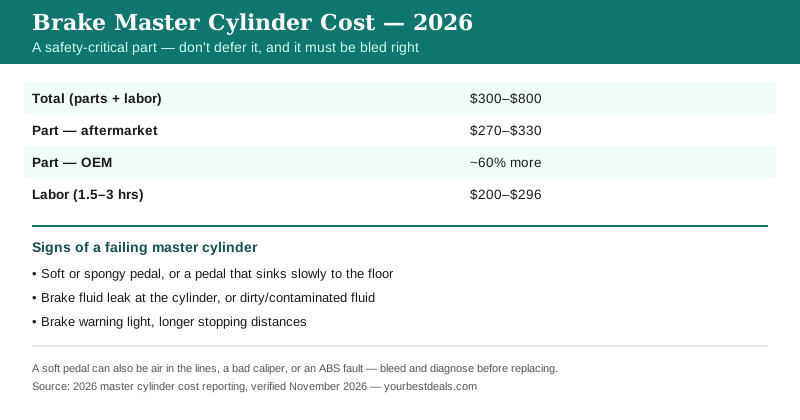
Brake master cylinder replacement in 2026 costs $300 to $800 total, with the part running $270 to $330 aftermarket (OEM about 60 percent more) and labor $200 to $296 for a 1.5-to-3-hour job. This is a safety-critical repair – the master cylinder builds the hydraulic pressure that stops your car – so it’s not one to defer or cut corners on. The two things that matter here are confirming the master cylinder is actually the problem and making sure the system is properly bled afterward.
Brakes are one of my ASE certs, A5, and the master cylinder is where I want people to slow down and think, because a soft pedal has several causes and the fix has to be done right. A car that won’t stop properly is not a place to guess or to save a few dollars on a sloppy bleed. This guide covers the real cost, how to tell a bad master cylinder from air in the lines or a bad caliper, and why the bleed is half the job.
Master cylinder cost breakdown
These are parts-and-labor figures. Most of the variation is the part choice and how accessible the cylinder is.
| Item | Cost | Notes |
|---|---|---|
| Total (parts + labor) | $300–$800 | Most cars mid-range |
| Part – aftermarket | $270–$330 | Quality aftermarket is fine |
| Part – OEM | ~60% more | For fussier vehicles |
| Labor (1.5–3 hrs) | $200–$296 | Includes bleeding the system |
A quality aftermarket master cylinder is fine on most cars, and OEM costs about 60 percent more without adding anything a mainstream vehicle needs. The labor includes bleeding the brakes afterward, which is not optional – a master cylinder installed without a proper bench bleed and system bleed will give you a soft pedal or worse, which on brakes is dangerous.
What gets misdiagnosed
A soft or sinking brake pedal points to the master cylinder, but it’s not the only cause, and this is one place where getting it right matters for safety, not just money. Air in the brake lines gives a soft pedal and is fixed by bleeding, not a new part. A leaking caliper or wheel cylinder, a bad brake hose, or an ABS-unit fault can all cause a low or soft pedal too. Replacing the master cylinder when air in the lines was the issue means you spent $500 and still have a soft pedal.
The master cylinder is the culprit when the pedal sinks slowly to the floor under steady pressure with no external leak, when fluid is leaking from the cylinder itself or into the brake booster, or when the fluid is contaminated with debris from internal wear. A good tech bleeds the system first to rule out air, checks for external leaks at the calipers and hoses, and confirms the pedal-sink behavior before condemning the master cylinder. On brakes, insist on that – a proper diagnosis is cheap insurance on a safety system.
Straight From the Invoice: brake-pedal jobs
These are jobs I either did myself or watched come through the bay – a real master cylinder, a soft pedal that was just air, and a leak that was a caliper.
Invoice #1 – 2014 Honda Accord, master cylinder, independent, Ohio
Pedal slowly sank to the floor under steady pressure with no external leak – classic internal master-cylinder failure. Aftermarket unit, bench-bled and installed, system bled, $460. Real deal. Lesson: a pedal that sinks under steady pressure with no leak is a genuine master cylinder, and $300 to $600 is fair with a proper bleed.
Invoice #2 – 2016 Toyota Camry, soft pedal that was air, Columbus
Soft pedal after a brake job elsewhere. The lines simply hadn’t been bled properly – a thorough bleed brought the pedal right back, no master cylinder needed. Lesson: a soft pedal right after brake work is usually air in the lines, and a proper bleed fixes it for a fraction of a master cylinder.
Invoice #3 – 2013 Ford Escape, low pedal that was a caliper, Texas
Low pedal and fluid loss, owner feared the master cylinder. The leak was a seized, leaking caliper – a cheaper fix, and the master cylinder was fine. Lesson: fluid loss with a low pedal can be a caliper or a hose; trace the leak before replacing the master cylinder.
Why the bleed is half the job
Bench bleeding and system bleeding
A master cylinder has to be bench-bled before installation – cycled with fluid to purge the air out of it – and then the whole brake system has to be bled afterward to remove any air that got in. Skip or rush either step and you get a soft, spongy pedal on a brand-new part, which defeats the repair and is unsafe. This is why the labor isn’t just bolting on a cylinder; a proper master cylinder job is as much about the bleed as the part. It’s also why I steer people away from the cheapest, fastest quote on this particular repair.
Don’t cut corners on brakes
The master cylinder is one repair where the lowest bid isn’t the goal. Brakes are the system that stops your car, and a botched bleed or a bargain-bin part that fails early is a real safety risk. Use a shop that does a proper bench and system bleed, and a quality aftermarket or OEM part, not a no-name cylinder. The difference between a good and a sloppy master cylinder job is a couple hundred dollars and, potentially, whether the car stops when you need it to.
Shop Talk
If you’ve got a soft pedal, the first thing to rule out is air in the lines, not a master cylinder – especially if it started right after other brake work, when a bad bleed is the usual cause. Ask the shop to bleed the system and check for external leaks before quoting you a cylinder. And when the master cylinder really is bad, make sure they bench-bleed the new one and do a full system bleed; a cylinder slapped on without that gives you a spongy pedal on a new part. This is the one repair where the cheapest, fastest quote is a red flag, not a deal.
What actually drives the price
Part choice and access, plus the bleed labor. A quality aftermarket cylinder keeps parts down; OEM adds about 60 percent for fussier vehicles. Access varies by how the cylinder and brake booster are packaged, and the labor always includes the essential bleed. Those factors put most jobs in the $300-to-$600 range, with higher-end and less-accessible vehicles pushing toward $800.
The avoidable cost is replacing a master cylinder when air in the lines, a caliper, or a hose was the real cause of a soft or low pedal. A bleed and a leak check rule those out for far less. But this is also the repair where you shouldn’t chase the cheapest quote – a proper bleed and a quality part are what make the brakes safe, and skimping there is a false economy on the one system that stops the car.
The Real Number
Budget $300 to $800 for a master cylinder, with a quality aftermarket part and a proper bleed being the fair job. First, rule out the cheaper causes of a soft pedal – air in the lines, a leaking caliper or hose – with a bleed and a leak check, since those cost far less. When the cylinder truly is bad, don’t chase the lowest bid: insist on a bench bleed and a full system bleed, because this is the one repair where a rushed job leaves you with a spongy pedal on the system that stops your car.
Frequently Asked Questions
How much does brake master cylinder replacement cost in 2026?
The total runs $300 to $800, with the part $270 to $330 aftermarket and about 60 percent more for OEM, plus labor of $200 to $296 for a 1.5-to-3-hour job that includes bleeding the brakes. A quality aftermarket cylinder is fine on most cars. The labor always includes the bench bleed and system bleed, which are essential – a master cylinder installed without a proper bleed gives a soft pedal on a new part. Most jobs land in the $300-to-$600 range, with less-accessible or higher-end vehicles pushing toward $800.
What are the symptoms of a bad master cylinder?
The classic signs are a soft or spongy brake pedal, a pedal that slowly sinks to the floor under steady pressure, brake fluid leaking at the cylinder or into the brake booster, contaminated or dirty brake fluid, a brake warning light, and longer stopping distances. The most telling is a pedal that sinks under steady foot pressure with no visible external leak, which points to internal seal failure. Because a soft pedal has other causes too, these symptoms should be confirmed with a bleed and a leak check before replacing the cylinder.
How do I know if it’s the master cylinder or air in the lines?
Bleed the brakes first. Air in the lines causes a soft pedal that firms up after a proper bleed, and it’s a common cause of a spongy pedal right after other brake work. A bad master cylinder causes a pedal that sinks slowly under steady pressure and doesn’t come back after bleeding, often with internal fluid contamination. The tell is whether a thorough bleed fixes the pedal – if it does, it was air; if the pedal still sinks, it’s the cylinder. Always bleed and check for external leaks before condemning the master cylinder.
Is it safe to drive with a bad master cylinder?
No, this is one to take seriously. The master cylinder generates the hydraulic pressure that stops your car, and a failing one can cause a sinking pedal, reduced braking power, and longer stopping distances that put you and others at real risk. A complete failure can leave you with little or no braking. If your pedal is soft, sinking, or you’ve lost braking confidence, don’t keep driving normally – get it to a shop safely or have it towed. Brakes are not a system to gamble on.
Why does the master cylinder need to be bled?
Because brakes are hydraulic, and any air trapped in the master cylinder or the lines compresses under pedal pressure, giving a soft, spongy pedal instead of firm braking. A new master cylinder has to be bench-bled before installation to purge air from the unit, and the whole system bled afterward to remove air introduced during the job. Skip or rush either and the brakes feel soft on a brand-new part, which is both a failed repair and a safety hazard. The bleed is real half the job on a master cylinder.
Can I use an aftermarket master cylinder?
Yes, a quality aftermarket master cylinder from a reputable brand is fine on most cars and costs about 60 percent less than OEM. The key word is quality – this is a safety part, so avoid the cheapest no-name cylinder, which can fail early or leak. A reputable aftermarket unit properly bench-bled and installed performs just as well as OEM. Save OEM for a luxury or newer vehicle that’s particular, but for a mainstream car, a good aftermarket cylinder installed with a proper bleed is the sensible, safe choice.
Why shouldn’t I just get the cheapest master cylinder quote?
Because on brakes, the cheapest, fastest quote often means a rushed bleed or a bargain part, and both are safety risks on the system that stops your car. A master cylinder installed without a proper bench and system bleed gives a soft pedal, and a no-name part can fail early. The difference between a good job and a sloppy one is a couple hundred dollars and, potentially, whether the car stops when you need it. This is the one repair where I’d pick a quality shop and part over the lowest bid every time.
Sources
Master cylinder cost ranges verified against 2026 parts-and-labor reporting on November 6, 2026. Ranges vary by vehicle, part choice, and region; confirm your exact price locally.
- RepairPal – brake master cylinder replacement cost estimate
- AutoNation Mobile Service – master cylinder cost, 2026
- AutoZone DIY – symptoms of a bad brake master cylinder
Related Guides
- Brake pad replacement cost
- Car repair cost estimator hub
- Brake pad and rotor replacement cost
- About Eddie Brennan – ASE Master technician

Eddie Brennan is an ASE Master Certified technician (including A5, Brakes) who spent 11 years at an independent shop in Columbus, OH, and treated a soft brake pedal as a diagnosis to get right, not a part to guess at. He writes the repair and diagnostic guides on Your Best Deals and takes no referral fees. He drives a 250,000-mile 2015 Subaru Outback and a 2020 Ford F-150.