
Last updated: November 3, 2026 – By Diane Holcomb
November 2026 update: reconfirmed recharge pricing and the recurring-recharge-means-leak point.
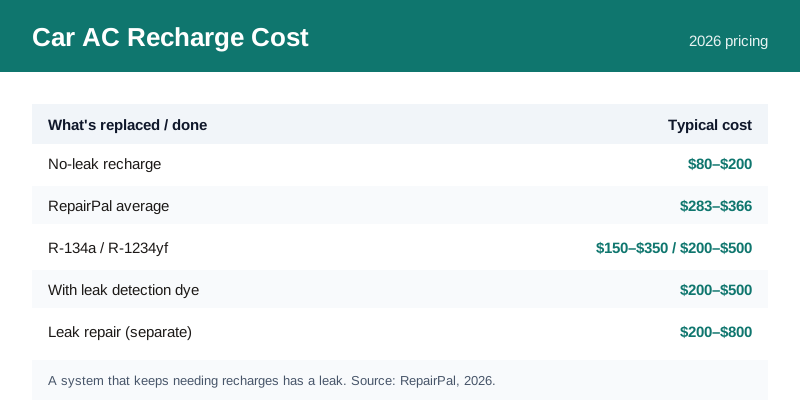
A car AC recharge runs about $80 to $200 when there’s no leak, though RepairPal’s average is higher at $283 to $366 (labor $178 to $261, parts about $104). The refrigerant type matters: older R-134a systems run $150 to $350, while newer R-1234yf systems run $200 to $500 because that refrigerant is much pricier. A recharge with leak detection dye is $200 to $500, and a separate leak repair commonly runs $200 to $800. An AC recharge refills the air conditioning system’s refrigerant to restore cold air. But here’s the key thing most people don’t know: refrigerant isn’t consumed – it circulates in a sealed loop and doesn’t get “used up.” So if your AC needs recharging again after a season or two, you don’t have a “low” system, you have a leak, and the right move is to find and fix it, not keep refilling.
The recharge is cheap, but the real question is whether you keep needing one. Let me cover the cost and the leak issue.
What you’ll actually pay
Here’s the picture. These are estimates that vary by vehicle and shop.
| Service | Cost | Notes |
|---|---|---|
| Recharge (no leak) | $80–$200 | Basic |
| RepairPal average | $283–$366 | Shop |
| R-134a / R-1234yf | $150–$350 / $200–$500 | By refrigerant |
| Leak repair (separate) | $200–$800 | The real fix |
AC problems often trace to specific parts; our AC leak repair guide, AC compressor guide, and AC condenser guide cover the components that leak.
Shop Talk
Here’s the thing nobody tells you about AC recharges: your car doesn’t “use” refrigerant. It’s a sealed system, so a properly working AC should hold its charge for many years. If your AC blew cold last summer and needs a recharge this summer, that’s a leak – period. So those cheap DIY recharge cans from the parts store, and quick recharge services, are really just refilling a leaking system that’ll be low again soon. They can get you cold air for a while, but you’re treating the symptom. The smarter path when AC goes warm is to have the system checked for leaks (a shop adds dye or uses an electronic detector, or does a pressure test) and fix the leak – a bad O-ring, a leaking hose, condenser, or compressor seal – then recharge. That costs more upfront but actually solves it. A few notes. One, those DIY cans with “stop-leak” additives can gum up or damage the system and complicate a proper repair later, so I’d steer clear of them. Two, the refrigerant type is a real cost factor: newer cars use R-1234yf, which is far more expensive than the old R-134a, so a recharge on a newer car costs more just for the refrigerant. Three, if the compressor is running and the system’s just low, a recharge helps; if the compressor won’t engage or there’s a bigger failure, a recharge alone won’t fix it. Get it diagnosed rather than repeatedly refilling.
Where Drivers Overpay
The real waste is repeatedly recharging a leaking system – each refill is cheap, but you’re paying again every season and never fixing the problem. When AC goes warm a second time, the money-smart move is a leak diagnosis and repair, not another refill.
The other trap is DIY cans with stop-leak additives, which can gum up or damage the system and make a proper repair costlier later. The pattern: a one-time recharge is fine if the system simply lost a little charge, but a recurring need means find and fix the leak, avoid stop-leak products, and recharge with the correct (sometimes pricey R-1234yf) refrigerant once it’s sealed.
The Real Number
An AC recharge is $80 to $200 with no leak (RepairPal averages $283 to $366); newer R-1234yf systems run $200 to $500 just for the pricier refrigerant. But refrigerant isn’t consumed – if your AC keeps needing recharges, it has a leak, and repeatedly refilling it (or using DIY stop-leak cans) wastes money and can cause damage. The smart move after a second warm-up is to find and fix the leak, then recharge.
Frequently Asked Questions
How much does a car AC recharge cost?
About $80 to $200 when there’s no leak and it’s a simple refill, though RepairPal’s shop average is higher at $283 to $366 (labor $178 to $261, parts about $104). The refrigerant type is a big factor: older R-134a systems run about $150 to $350, while newer R-1234yf systems run $200 to $500 because that refrigerant is much more expensive. A recharge that includes leak detection dye runs $200 to $500, and a separate leak repair commonly adds $200 to $800. These are estimates that vary by vehicle and shop. Because refrigerant circulates in a sealed loop and isn’t consumed, a system that needs recharging again soon has a leak – so the long-term cost depends on whether you just recharge or actually fix the leak.
What does an AC recharge do?
An AC recharge refills the air conditioning system’s refrigerant to the correct level so it can produce cold air again. The AC works by circulating refrigerant through a sealed loop – the compressor pressurizes it, the condenser and evaporator move heat, and the refrigerant’s phase changes cool the air blown into the cabin. The system needs the right amount (charge) of refrigerant to cool properly. A recharge evacuates and refills (or tops up) that refrigerant, often with a machine that measures the exact charge, sometimes adding oil or dye. It restores cold air when the only issue was a low charge. Importantly, a recharge doesn’t repair anything – it just refills the refrigerant – so if the system lost refrigerant through a leak, a recharge is temporary unless the leak is also fixed.
Why does my AC keep needing to be recharged?
Because you have a leak – this is the single most important thing to understand about AC. The air conditioning system is sealed, and refrigerant isn’t consumed or burned off in normal operation; it circulates in a closed loop. So a healthy AC system holds its charge for many years. If your AC blows cold after a recharge but goes warm again within a season or two, refrigerant is escaping through a leak somewhere – a worn O-ring or seal, a leaking hose, a corroded condenser, or the compressor. Repeatedly recharging it just refills a leaking system temporarily, costing you again each time and never solving it. The right approach is to have the leak located (with dye or an electronic detector) and repaired, then recharge. So “keeps needing a recharge” always means “has a leak to fix.”
What’s the difference between R-134a and R-1234yf?
They’re two different refrigerants, and which your car uses significantly affects recharge cost. R-134a is the older refrigerant used in most vehicles built before roughly the mid-2010s. R-1234yf is the newer, more environmentally friendly refrigerant that newer vehicles use (it has a much lower global-warming potential and is now standard on new cars). The practical difference for you is price: R-1234yf is considerably more expensive than R-134a, so recharging a newer R-1234yf-equipped car costs more just for the refrigerant – often $200 to $500 versus $150 to $350 for R-134a. They’re not interchangeable, and the systems use different fittings, so the correct refrigerant must be used. If you have a newer car and are surprised an AC recharge costs more, the pricier R-1234yf refrigerant is usually why.
Are DIY AC recharge cans worth it?
They’re tempting because they’re cheap, but they come with real downsides. A DIY recharge can from the parts store can get your AC blowing cold again if the system is simply a little low, and for a quick, short-term fix on an older R-134a car it can work. But there are cautions: many of these cans include “stop-leak” additives that can gum up or damage the AC system and complicate (and raise the cost of) a proper repair later, so they’re best avoided. Overcharging the system with a DIY can is also easy and can harm the compressor. And fundamentally, if your system needs recharging, it has a leak – a DIY can just refills it temporarily without fixing that. Newer R-1234yf systems aren’t suited to simple DIY cans either. So for anything beyond a one-time top-up on an old car, a proper shop diagnosis and recharge is the better value.
Will a recharge fix my AC if it’s blowing warm?
Only if low refrigerant was the actual problem. If the AC is blowing warm simply because the system is low on refrigerant (from a slow leak), a recharge will restore cold air – at least until the leak empties it again. But AC blows warm for other reasons a recharge won’t fix: a failed compressor (or one that won’t engage), a bad compressor clutch, an electrical problem, a blend door or control issue, a clogged system, or a failed component like the condenser or expansion valve. In those cases, adding refrigerant does nothing. That’s why diagnosis matters: a shop checks the system pressures, whether the compressor engages, and for leaks before just recharging. If the only issue is a low charge, a recharge (plus fixing any leak) solves it; if there’s a component failure, you need that repair instead. Don’t assume a recharge is the cure for every warm-AC problem.
How long should an AC recharge last?
In a properly sealed, leak-free system, a recharge should last many years – essentially, you shouldn’t need routine recharges at all, because the refrigerant isn’t consumed. A correctly charged, healthy AC system can hold its refrigerant for the better part of a decade or more. So the real answer is that a recharge “lasts” as long as the system stays sealed. If a recharge only lasts a season or a year, that’s a clear sign of a leak, not normal refrigerant loss. This is the opposite of something like an oil change that you repeat on a schedule – AC refrigerant isn’t a consumable maintenance item. So if someone tells you your AC needs “topping off” every year as routine maintenance, be skeptical: a healthy system doesn’t need that, and a recurring need points to a leak that should be repaired.
Sources
Price ranges verified against 2026 AC recharge pricing in November 2026. Dollar amounts are estimates that vary by vehicle and shop.
- RepairPal – repair cost estimator
- thePricer – AC recharge cost
- ASE – National Institute for Automotive Service Excellence
Related Guides
- Car AC Leak Repair Cost
- AC Compressor Replacement Cost
- AC Condenser Replacement Cost
- AC Repair Cost
- Car Repair Cost Estimator

Diane Holcomb spent seven years as a service advisor at multi-brand dealerships in Charlotte, NC, where she’d explain that a car that needs an AC recharge every summer doesn’t need refrigerant – it needs its leak found and fixed. She drives a 2019 Honda CR-V and a hand-me-down 2007 Toyota Camry, and takes no referral fees or advertising money from any shop or chain.